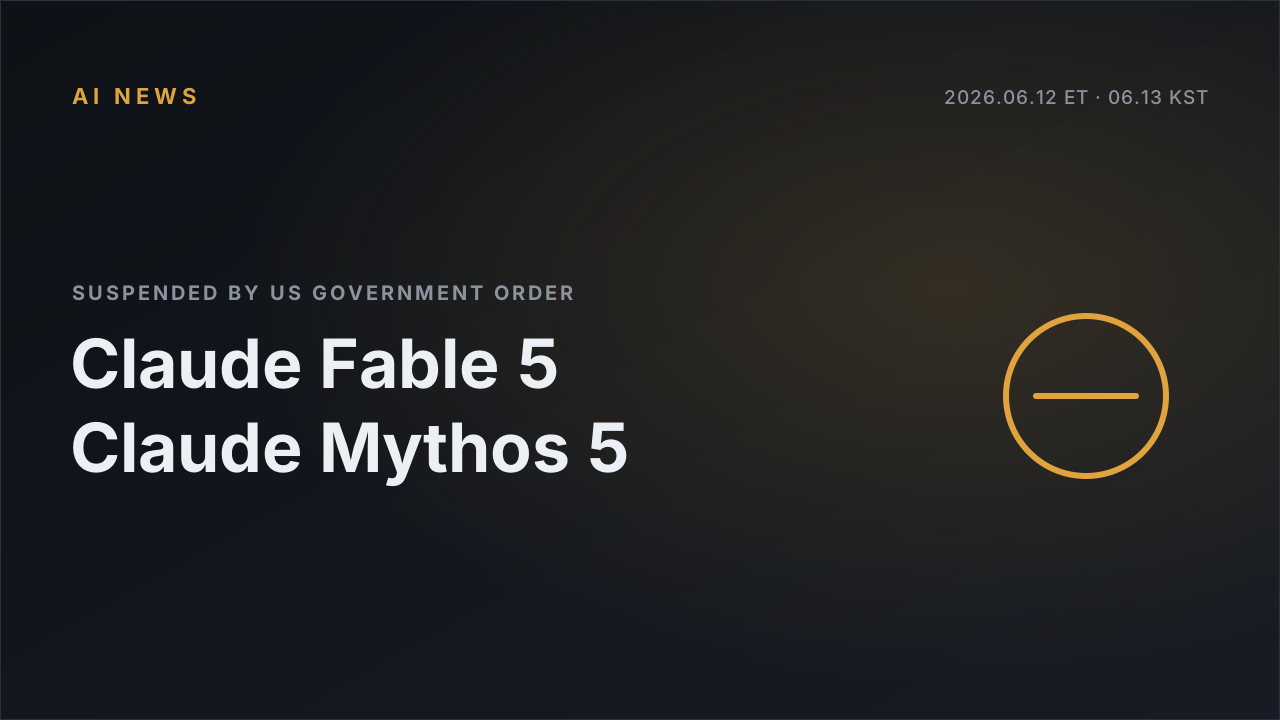
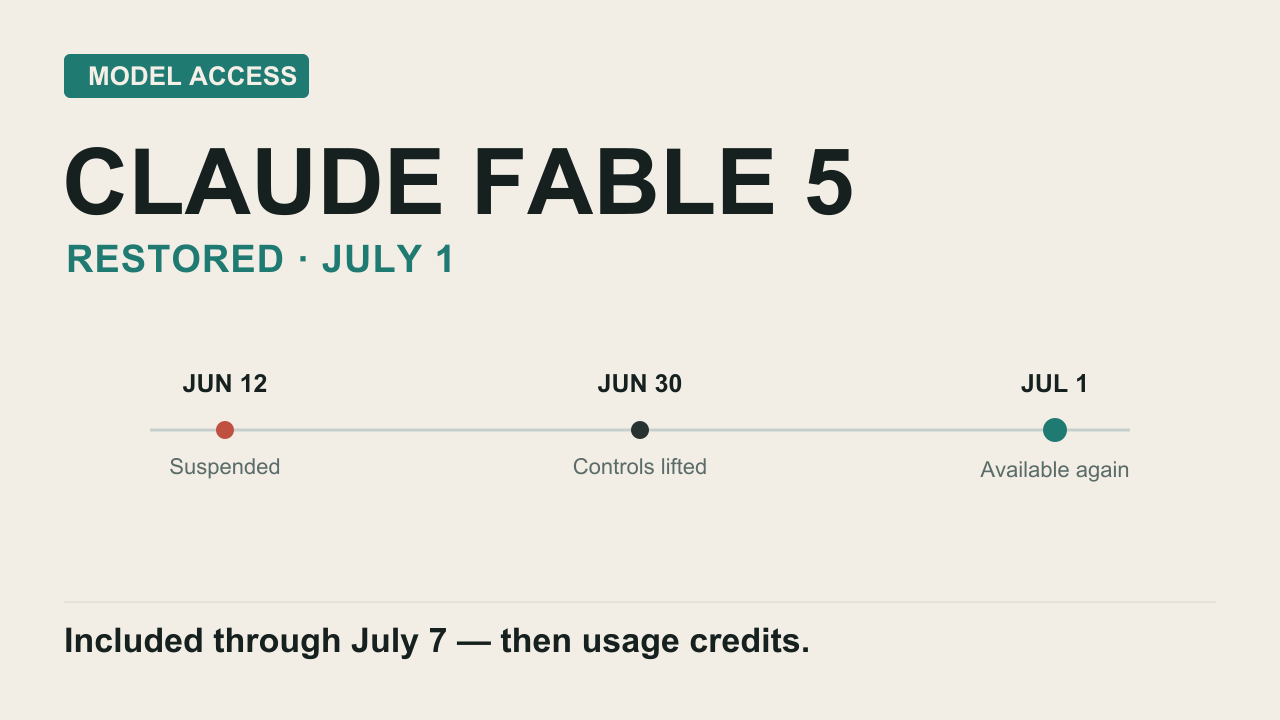
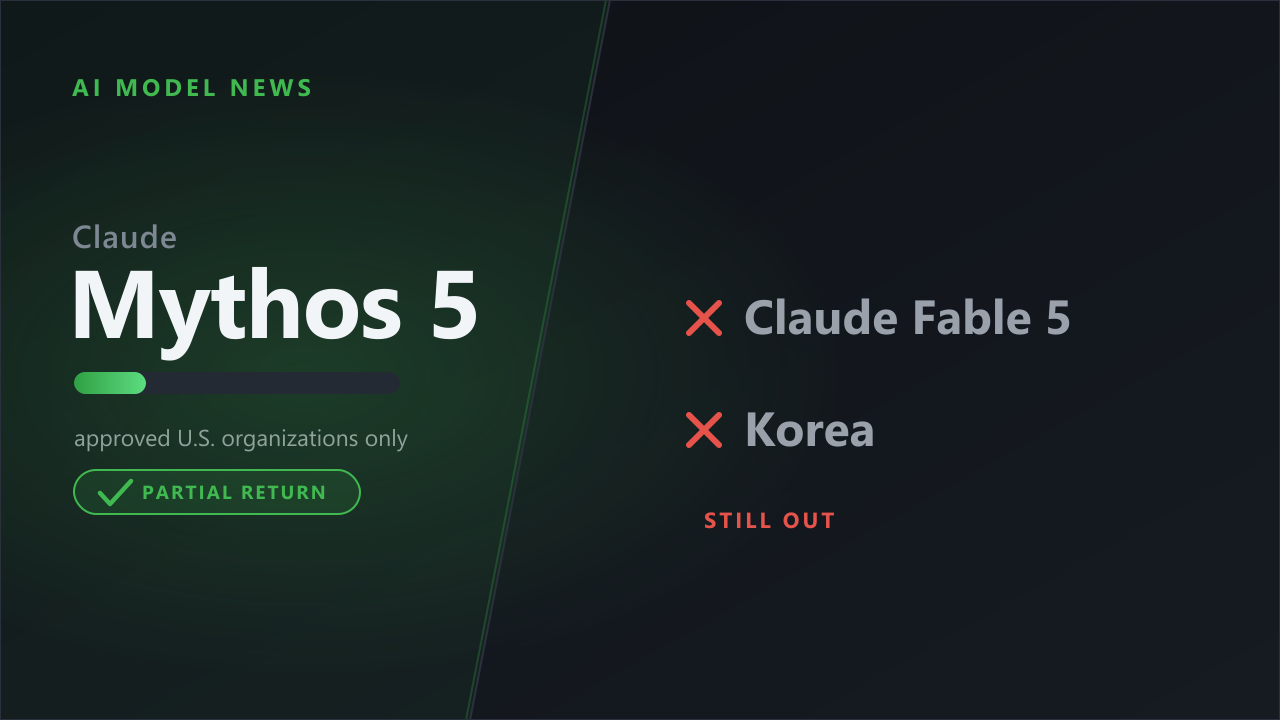
On June 12, 2026, a U.S. government export-control directive cut off Claude Fable 5 and Claude Mythos 5 for customers worldwide (companion piece). A few days later, China's Z.ai released GLM-5.2, putting the model files on Hugging Face under an MIT license — a model anyone can download and run.
The story isn't "a Chinese model beat Fable 5." More precisely: a downloadable, self-hostable open model now sits in the same comparison tables as the closed top-tier models, measured against them category by category. First in some columns, mid-pack in others — and at a fraction of the price.
What the model is
GLM-5.2 is the flagship open model Z.ai released in mid-June 2026: open weights (MIT), a 1-million-token context window, and up to 128K tokens of output. Z.ai positions it for long-horizon work — holding on to a large codebase across many steps rather than answering short questions — with reasoning effort selectable between High and Max.
By the Hugging Face model card, it has 753B parameters (some outlets report 744B). But "released openly" and "easy to run on any hardware" are not the same thing. This isn't something you can run on an ordinary personal computer: per the SGLang and vLLM deployment docs, running it yourself takes a single node of eight H200 GPUs at FP8 (about 1.1TB of VRAM) — Z.ai's own documentation lists no hardware requirements at all.
The same table, different columns
What is interesting about GLM-5.2 is less how high its scores are than which models those scores are set against. On external leaderboards, it enters the same tables as the closed top-tier models. As of June 25, three of them, side by side:
- Design Arena · Code Categories (a blind, user-preference test in which people compare and pick single-file HTML design and coding outputs) — GLM-5.2 ranks #1 at Elo 1363, and Claude Fable 5 #2 at 1350. But that Fable 5 is marked "Inactive": shut down by export controls, it can no longer be used. GLM-5.2, in effect, passed a model that had already gone offline to reach #1. The test itself is one some designers distrust in the first place (Interconnects).
- Design Arena · Full-Stack (an agentic test that builds complete React apps, with authentication, a database, and a backend) — here Claude Opus 4.7 (1391) and Opus 4.8 (1328) sit above GLM-5.2 (1301), which ranks #3.
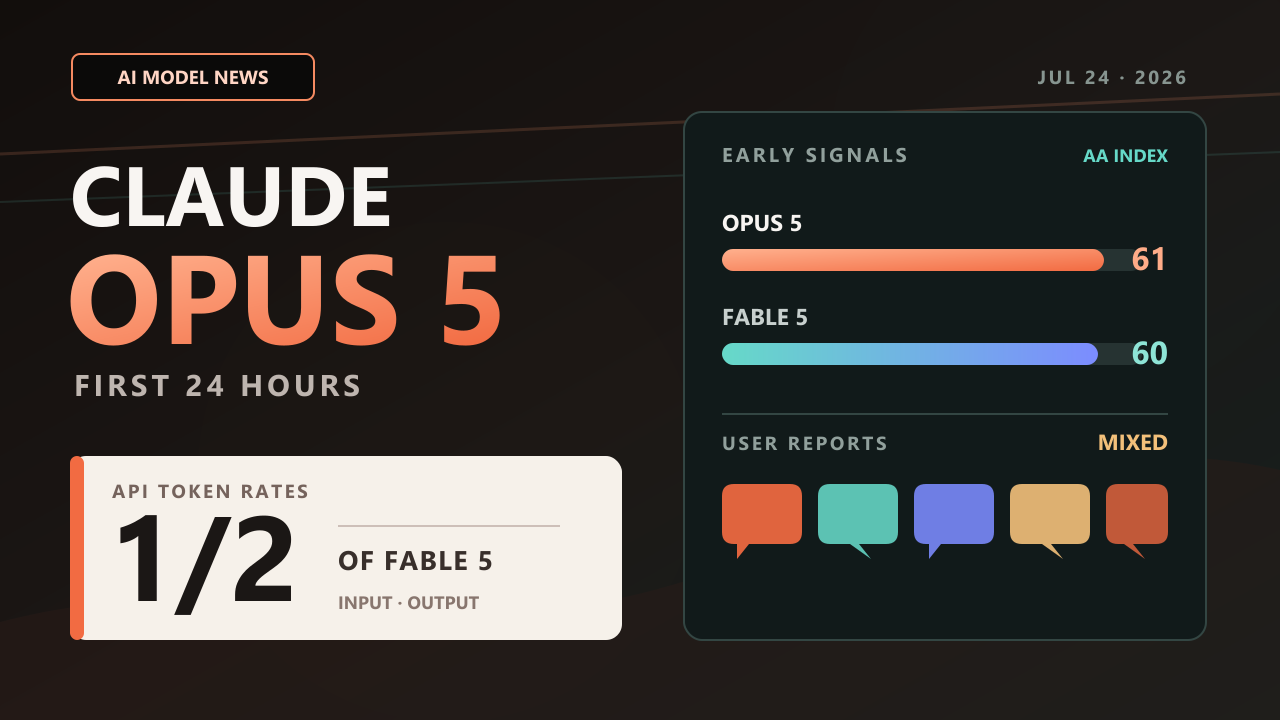
- Artificial Analysis · Intelligence Index (an overall intelligence measure) — Claude Fable 5 leads at 60, with Opus 4.8 at 56, GPT-5.5 at 55, and GLM-5.2 (max) at 51. On the overall measure, Fable 5 and Opus are still ahead.
So this much can be said:
GLM-5.2 has reached the top of some coding and design-preference leaderboards, and across several tables it is measured category by category against the closed top-tier models.
But not this:
GLM-5.2 is a better model than Fable 5.
Z.ai's own benchmark table does not pit it directly against Fable 5. It lines up Opus 4.8, GPT-5.5, Gemini 3.1 Pro, and others, and reports GLM-5.2 as close to Opus 4.8 or ahead of GPT-5.5 on some long-horizon coding metrics (for example, FrontierSWE 74.4 — GPT-5.5 72.6, Opus 4.8 75.1). These are the company's own numbers, not independently verified ones.
Price and access
The sharper difference is not the scores — it is the price. As of June 25, Artificial Analysis lists a blended token price of about $0.90 per million tokens for GLM-5.2, against about $7.70 for Fable 5. On the same site's long-horizon project test (AA-Briefcase), the cost per task comes to $2.40 for GLM-5.2, $10.40 for Opus 4.8, and $31 for Fable 5 — Fable 5 and Opus are stronger, but GLM-5.2 is the cheapest to run.
That gap registers well beyond coding. Chris Saum, of the investment firm Active Capital, said his daily AI bill fell from about $300 to $3.82 after he moved from Claude to GLM (Analytics India Magazine; a single account).
Access compounds it. Fable 5 still leads the overall intelligence index, yet it is the one model that cannot be used right now — stopped by a single line of a government directive. GLM-5.2 raises the opposite question: a model you've downloaded and run on your own hardware is one no one can switch off from outside. Several commentators tie GLM-5.2's timing directly to the Fable 5 shutdown (Interconnects, Analytics India Magazine).
So what changed
The view of Chinese open models as "cheap, good-enough alternatives" no longer fits — at least for coding and long-horizon work. GLM-5.2 has not beaten Fable 5 across the board. It still trails on the overall measure, and where Fable 5 is live, Fable 5 leads.
What changed is the table itself. A downloadable, self-hosted open model is now compared with the closed top-tier models in the same columns, category by category, at a fraction of the price. Elon Musk predicted China would have a Fable 5-class model "around the first quarter of next year"; Z.ai founder Tang Jie replied that it "won't take that long" (per SCMP). That exchange is about a future open Fable-class model, not GLM-5.2 today.
AI model competition no longer reads as a single question of "who is smartest." What it does well. What it costs. And — who holds the controls.
Sources
- Z.ai / Hugging Face: GLM-5.2 blog
- Hugging Face: zai-org/GLM-5.2 (model card)
- Z.ai Developer Document: GLM-5.2 · Pricing
- Design Arena: Code Categories · Full-Stack (as of June 25)
- Artificial Analysis: LLM Leaderboard (as of June 25)
- Anthropic: Claude Fable 5 and Claude Mythos 5
- Interconnects: GLM-5.2 is the step change for open agents
- Analytics India Magazine: GLM 5.2 wins over developers after Anthropic Fable ban
- SCMP: China AI ready to match Anthropic's Fable 5? Musk, Zhipu's Tang clash over GLM-5.2 rise
- Companion piece: Stopped by a government order: Claude Fable 5 and Mythos 5