OpenAI unveiled its next-generation model, GPT-5.6, on June 26. This is not a general release anyone can use right away; it is a preview opened first to a limited group. OpenAI said a broad release through ChatGPT, Codex, and the API would follow within weeks.
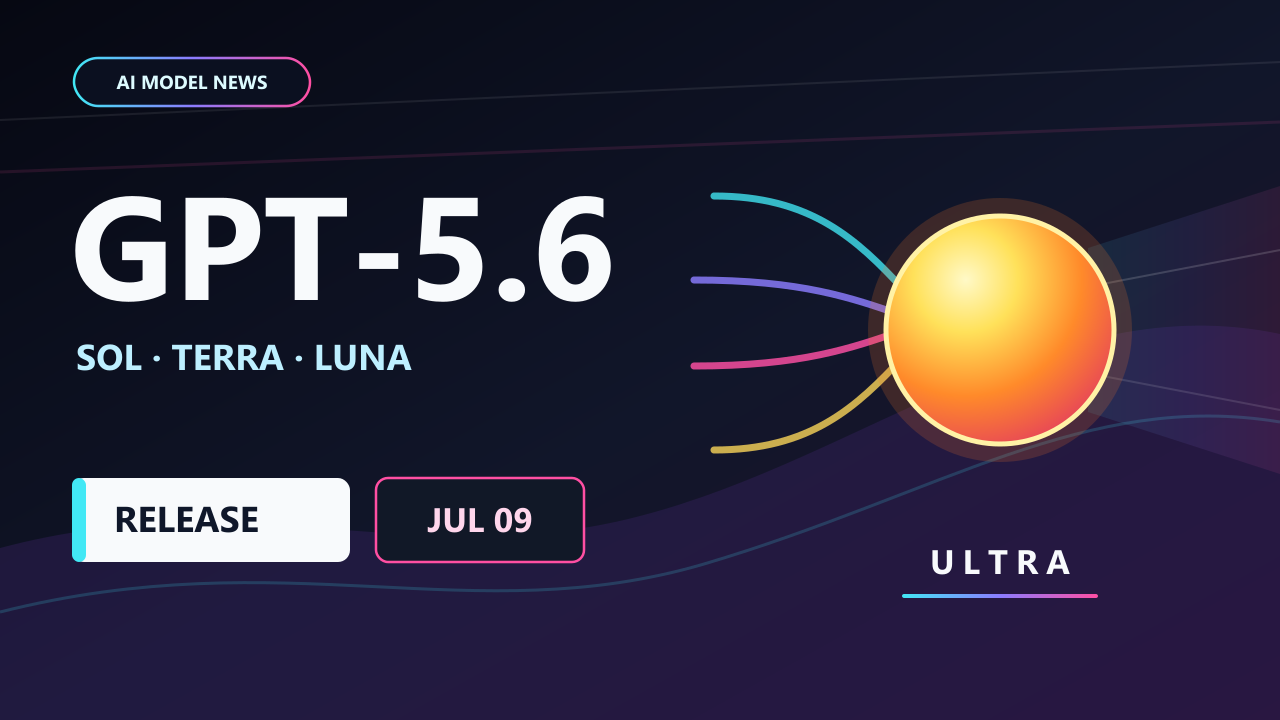
GPT-5.6 is not one model but three: Sol, Terra, and Luna. OpenAI presented Sol as its new top-tier model and Terra and Luna as more affordable options, and it released pricing and a safety report alongside them.
A next generation split into three models
GPT-5.6 comes as three models: Sol, Terra, and Luna. By OpenAI's account, Sol is the new flagship; Terra delivers performance comparable to the previous-generation GPT-5.5 at half the price; and Luna is the fastest and lowest-cost of the three.
OpenAI said Sol adds a new "max" reasoning effort, which lets it think longer, and an "ultra" mode that runs several subagents at once. It did not say what names these settings will use, or what access limits will apply, in the shipped products or API.
By the announcement's figures, the prices per million tokens (the small units of text used for billing) are $5 for input and $30 for output on Sol, $2.50 and $15 on Terra, and $1 and $6 on Luna. These are the company's stated prices; as of June 30, OpenAI's official pricing documentation still showed no GPT-5.6 row. On the same page, the current flagship, GPT-5.5, is listed at $5 input and $30 output — the same as Sol's announced price.
What OpenAI says improved
OpenAI stresses gains on longer-running work. The figures below are the company's own, drawn from its announcement and system card:
- Coding and agentic work (automated tasks the model carries out over many steps on its own): OpenAI claimed Sol set a new state of the art (SOTA) on Terminal-Bench 2.1, a benchmark for executing terminal commands. The system card says Sol and Terra improved over GPT-5.5 on long-running tasks such as internal research debugging and kernel optimization.
- Health: HealthBench Professional is an OpenAI evaluation of medical question-answering and clinical-judgment support — not exercise or fitness. According to the system card, its length-adjusted score rose from 51.8 for GPT-5.5 to 60.5 for Sol (the company's own evaluation, not independently verified, and not necessarily the same as real clinical performance).
- Cost and speed: From GPT-5.6 on, OpenAI revised the caching that reduces costs when the same content is sent again: the breakpoints where a request is split and stored can be set explicitly, and are kept for at least 30 minutes. OpenAI also said it would serve Sol on Cerebras hardware at up to 750 tokens per second in July — a stated target, available to select customers at first.
What the safety report says
Alongside GPT-5.6, OpenAI released a system card — a document in which the company assesses its own model's risks. It focuses on cybersecurity, biology, and chemistry. Under its own safety standard, the Preparedness Framework (OpenAI's own risk-assessment framework), OpenAI rated all three models as "High" capability but below the most dangerous "Critical" level — its own assessment.
To support its "High but not Critical" rating in cyber, OpenAI's announcement says that on a browser-vulnerability evaluation Sol identified bugs and exploitation primitives — the building blocks of an exploit — but did not autonomously produce a functional, full-chain exploit under the conditions tested. The system card says that in biology and chemistry some wet-lab support metrics crossed the threshold, while Critical metrics such as designing a novel pathogen were not. All of this is OpenAI's own assessment.
OpenAI said it had shared information about some of the preview's partners with the U.S. government, and that it would publish an updated system card at general availability.
When, and to whom, it opens
For now, OpenAI says selected trusted partners and organizations can access GPT-5.6 through the API and Codex. OpenAI said it would widen this to a general release across ChatGPT, Codex, and the API, but it has given no exact date, pricing tier, or list of countries beyond "in the coming weeks" and "soon."
As of June 30, OpenAI's developer documentation still recommends GPT-5.5 by default, and GPT-5.6 appears only as a single banner at the top of the page: "GPT-5.6 is available to select trusted partners in preview. Broad availability coming soon." It remains, in other words, one step short of general availability.
For Korea
A Korea-specific release, Korean-language performance, and any domestic partnerships do not appear in the announcement or the system card. GPT-5.6's pricing and caching charges would factor into cost calculations if a general release reaches Korean accounts, but as of June 30 it could not be confirmed from official documentation whether Korean accounts can access this preview, or where their data would be processed.
Sources
- OpenAI: Previewing GPT-5.6 Sol: a next-generation model
- OpenAI: GPT-5.6 Preview System Card
- OpenAI API documentation: Models · Pricing (as of June 30)